
Px3: An Employee Engagement Survey, or Driver of Business Value?
Explore how the Px3 framework transforms employee engagement surveys into a tool for driving business value. By connecting the perceived environment, felt experience, and people outcomes, Px3 delivers actionable insights, supports meaningful work, and strengthens your people strategy and EVP.
Px3: An Employee Engagement Survey, or Driver of Business Value?
In my experience, most of the people that we speak to that are buying employee engagement surveys are focused more on features than benefits, and while some want to know that there is science behind it, few really see their survey as a driver of business value.
I might be biased, because I created Px3, but that’s exactly what it can do for you. A survey built with Px3 isn’t ‘just’ an employee engagement survey. While Px3 isn’t the survey itself, it’s the framework that underpins it — providing the structure and intent needed to drive real insight.
So what is Px3 and How Does it Relate to Employee Engagement Surveys?
Px3 is a simple but powerful framework that we at The People Experience Hub use to design and analyse employee surveys, to help you get under the skin of your people’s experiences at work and deliver better people outcomes. That includes, but is not limited to, Employee Engagement.
So, let’s start with “is not limited to”.
Px3 Is and Isn’t a Model of Employee Engagement
In Px3, employee engagement is a People Outcome, which is the third level in the framework. It’s the DO, in THINK, FEEL and DO.

Other People Outcomes are available, including wellbeing (or indeed negatives like stress and burnout), behavioural intentions (let’s say you have specified behaviours for your business), performance (we can bring performance data into the survey) or change readiness.
And these aren’t either/or choices. Your Px3 survey can be both an employee engagement survey and a wellbeing survey, for example. But when we measure engagement it most commonly includes questions about:
- Intentions to stay (commitment)
- Willingness to recommend the company as an employer (advocacy, or eNPS)
- Motivation
But there’s also another view of employee engagement as an “umbrella” term for your people strategy and initiatives, and Px3 can certainly be that. In fact, we use “Px” deliberately, because it refers to the overall experience of your people at work.
When we talk about the think, feel and do, we’re deliberately separating that experience into three levels or buckets. We’ve now talked about People Outcomes, and the other two are the Perceived Environment and Felt Experience.
Think: The Perceived Environment
Let’s talk about the Perceived Environment first, because it’s the first level in the Px3 framework and it’s very simple. The Perceived Environment refers to the more tangible aspects of the work environment, the things that are manageable and, importantly, where the action happens once your survey is done.
This can include things like communication, management and leadership, ways of working, people practices and even sustainability.
The important thing about separating these from the Felt Experience is that it leads to highly actionable insights for your management to take. We don’t tell managers, “try improving belonging”. We say, “show your team more respect”, or “recognise them for their work”.
However, it is useful to know that if you show your team more respect and recognise them for their work, they will feel a greater sense of belonging and are more likely to want to stay or recommend you as an employer.
That’s what Px3 does, and it does this by introducing a ‘middle’ level: The Felt Experience.
Feel: Felt Experience
On its own, the Felt Experience is valuable and worth highlighting. It’s less valuable to managers, but to people and engagement specialists, it’s gold dust.
The Felt Experience is ‘emotional’. I use inverted commas here because we’re generally not measuring raw emotions such as joy, fear or anger, but are measuring positive experiences including purpose, autonomy, growth, connection, belonging and enjoyment.
Motivation and Satisfaction
These experiences, which are grounded in motivational theory (Self-Determination Theory and Reversal Theory) have strong associations not only with engagement but with wellbeing. When people score well in the Felt Experience overall, we can say that their human needs are being satisfied. And isn’t that a good thing?
Meaningful Work
So, the Felt Experience can be thought of as a measure of work satisfaction. But it’s also very closely related to the concept of meaningful work, which is becoming increasingly important to think about. It’s not necessarily enough to say that your people are engaged, when people crave meaningfulness.
Indeed, meaningfulness might be a more important concept, in time, than engagement. Why?
Research suggests that meaningful work is associated positively with general life satisfaction, wellbeing and happiness, and with lower stress; while also improving engagement and the outcomes associated. These include reduced turnover intention, patient satisfaction in health (and therefore customer satisfaction is a likely benefit), organisational reputation, creativity and perceived performance.
According to Sandoghar and Bailey from King’s Business School, people are willing to sacrifice salary and career advancement for meaningfulness. And with a greater focus on sustainability, there is greater scrutiny on the quality of work that employers provide (as per the UN Sustainability Goals).
So, meaningful work is win:win.
The Felt Experience and EVP
Another important concept that the Felt Experience relates to is the Employer Value Proposition or EVP, which represents the ‘deal’ between the employer and employees. A strong EVP should be more than pay and other benefits, and should incorporate emotional aspects of the deal. If you run an employee survey built with Px3, you’ll get insights into the kinds of experience that your people or, more precisely, different groups of people that work for you, want.
So, all this is great, right?
We’ve described how each of the levels of Px3 are important in their own right. But we haven’t got to the ‘magic’ yet.
Px3 Connects the Think, Feel and Do of Employee Engagement
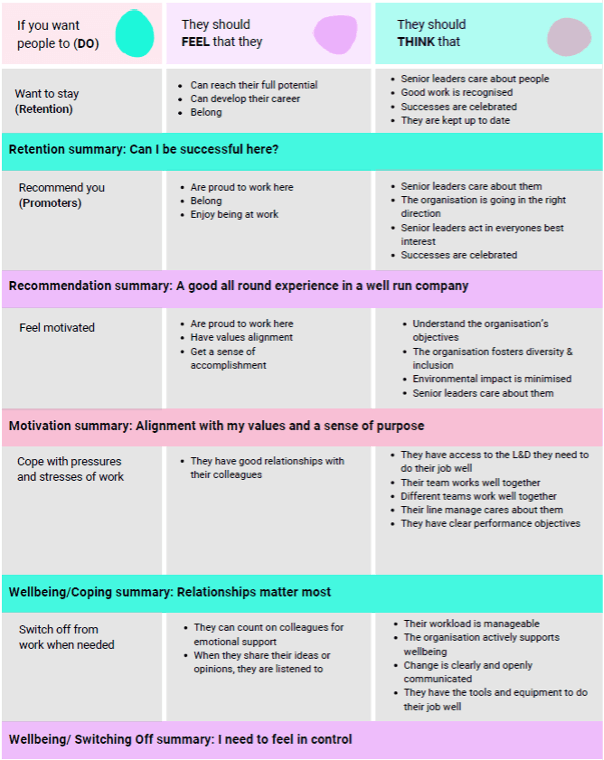
When you run an employee engagement survey using Px3, we calculate the statistical relationships that run from what people think about the organisation (Perceived Environment), through how they feel (Felt Experience) to how engaged (willing to recommend / likely to stay / motivated), well or performing (People Outcomes) they are.
Using this analysis, which is a bit like a value chain analysis, we can give your managers clarity, by showing them which manageable (think) questions they can improve to have the most impact on employee engagement (and go straight to action), but for you as people specialists we can tell a more compelling story about what experiences your people value most, how to deliver them and what impact that will have on outcomes. This will help you develop more effective people strategies, cultures or EVP.
And if your people outcomes are aligned to your business strategy – then you can indeed turn your employee engagement survey into a real driver of business value!
These examples are from our own 2024 Insights Report
In Conclusion
By way of a summary, Px3 is not just an employee engagement model. It’s a powerful and versatile framework designed to help you set clear priorities that drive better people outcomes and deliver meaningful experiences of work. I thought I’d try and list some of the ‘big questions’ it can help you answer:
- What will help us to improve employee engagement, wellbeing or performance?
- How can we make work more satisfying and meaningful?
- How can we improve our retention?
- How can we turn our people into advocates?
- How do we build a better work environment, and what does ‘better’ look like here?
- What do our people (or specific groups of people) value most at work?
- What should the emotional elements of our EVP or ‘deal’ look like?
- How can we improve our people strategy?
- How well are we doing on executing our people strategy?
- What can we focus on to have to the most positive impact on our people?
I’m sure there’s more – can you think of some?
And if you’d like to learn more about Px3 and how it can help you to deliver better people outcomes, book a meeting.