
Exploring The Hospitality Culture Report: What You Need to Know
The Hospitality Culture Report uncovers the truth behind falling engagement, FOH/BOH divides, and the emotional drivers that shape guest experience — proving culture is now a commercial strategy. If you only read one thing… start here.
Exploring The Hospitality Culture Report: What You Need to Know
The hospitality sector has seen its fair share of turbulence, cost pressures, workforce shortages, shifting consumer expectations, and a need for ever‑higher service standards. But underneath all of this sits one constant truth:
Your people are the experience.
This year’s Hospitality Culture Report shows, with crystal clarity, where the real levers for performance lie, and where hospitality leaders must focus if they want to retain talent, deliver exceptional guest experiences, and build commercially resilient cultures.
Before we dive in, let’s start with the most important part:
If You Only Read One Thing… Read This
Hospitality succeeds or struggles based on their people's experience at work.
The data shows three key areas of focus:
- The Felt Experience is hospitality’s superpower
Connection (80.7%), Belonging (78.5%) and Enjoyment (71.4%) score higher than almost every other part of the employee experience. When people feel connected and proud, service thrives.
2. Engagement is slipping, and it’s a commercial risk
Hospitality engagement sits 4.9 percentage points below the all‑industry benchmark, driven by a drop in intention to stay (-6.4pp) and motivation (-4.3pp).
3. FOH and BOH live different realities
These differences shape teamwork, clarity, workload, inclusion, and ultimately, guest or customer experience. Ignoring this divide is no longer an option.
Everything else in the report builds from these three points.
If leaders improve connection, purpose, clarity, and cross‑team cohesion, performance rises.
If they don’t, the problems compound quickly.
Breaking Down the Big Themes
1. Employee Engagement: A Board‑Level Problem to Solve
What the report tells us:
Engagement in hospitality sits 4.9pp below the all‑industry benchmark, with intention to stay (–6.4pp) and motivation (-4.3pp) dragging the numbers down. This isn’t a minor wobble; it’s a warning sign. Hospitality colleagues are committed (74.5%), but they want more support, clearer direction, and fewer operational blockers.
Your takeaway:
Engagement can’t just sit in HR or the people team, it belongs at the board table.
Retention, motivation, and advocacy directly shape service quality and operational consistency. If leadership doesn’t invest here, customers will feel it before leaders see it.
2. Taking Action: What Really Drives People Outcomes
What the report tells us:
Using the Px3™ model (Think, Feel, Do), the report identifies the factors that influence retention, motivation, and advocacy. The strongest drivers include:
- Work‑life balance
- Trust in senior leaders
- Line manager support
- Recognition
- Pride and belonging
- Feeling part of the community
These aren’t perks, they’re core experience drivers.
Your takeaway:
If you want people to stay, be motivated, and recommend you, stop guessing.
- Start listening to the data.
- Build line manager capability.
- Recognise great work.
- Support work‑life balance.
- And create a culture people feel proud of.
3. The Hospitality Experience: The Power of Human Emotion
What the report tells us:
The highest scoring elements of all are in the Felt Experience:
- Connection (80.7%)
- Belonging (78.5%)
- Enjoyment (71.4%)
People thrive when they feel part of something. These emotions show up in guest and customer interactions, and they’re your competitive edge. Teamwork (72.3%) and line management (70.4%) also score highly, while company leadership lags behind at 61.2%.
Your takeaway:
Culture isn’t an initiative, it’s the daily emotional reality of your people, and it defines how they serve.
If you get the human experience right, the customer experience follows naturally.
Connection is not “soft”. It's commercial.
4. The Environment: Where Hospitality Must Step Up
What the report tells us:
The weakest scores come from People Practices (60.8%), Leadership (61.2%), and Communication (63.3%).
These are important for, clarity, fairness, consistency, and direction. Without them, you can have trust issues.
Potential burnout‑related areas like wellbeing (64.1%) also need focus.
Your takeaway:
Fix the basics, your teams don’t need a new mission statement, they need:
- Clear comms
- Reliable systems
- Stronger leadership visibility
- Fair processes
- Manageable workloads
Stop adding friction to your peoples day, it drains their emotional bank.
5. FOH and BOH: A Tale of Two Cities
What the report tells us:
The differences are stark:
- BOH are frustrated by poor systems and tools
- BOH are less likely to feel they belong
- FOH report poor clarity on performance objectives
- BOH show higher advocacy for the industry
These gaps shape culture, teamwork, and service consistency.
Your takeaway:
FOH and BOH cannot deliver a seamless customer experience if they experience two different cultures.
Leaders must:
- Fix BOH tools and tech
- Improve FOH clarity
- Build shared purpose
- Cross‑train
- Celebrate wins across both sides
When FOH and BOH work as “one team”, the guest or customer experience feels the benefit.
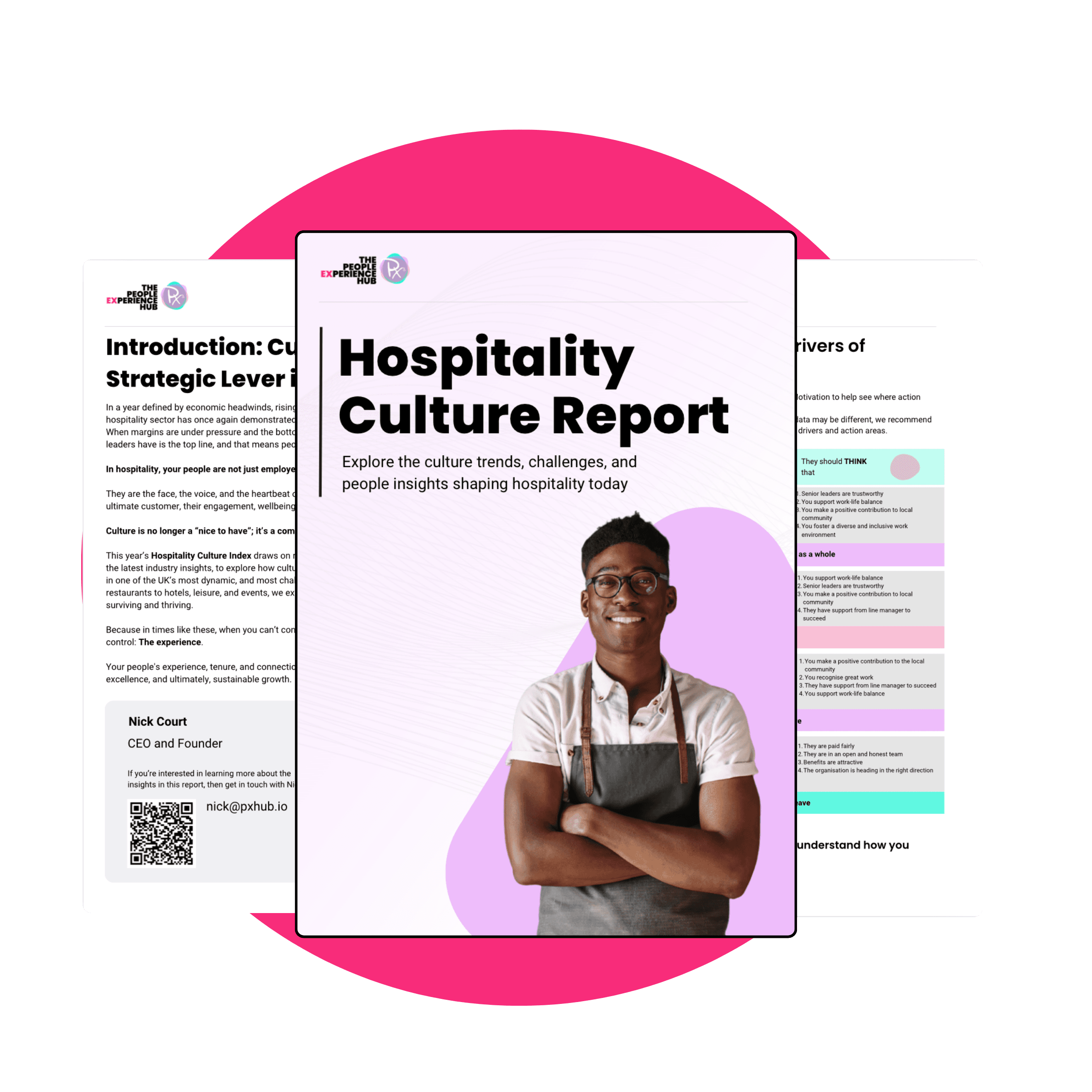
Download The Hospitality Culture Report
Ready to dive deeper into the data behind these insights? Download The Hospitality Culture Report to explore the full findings.
Download the report6. The Service Profit Chain: Why People Drive Profit
What the report tells us:
Higher employee engagement → stronger customer loyalty → higher profitability.
The Hospitality Culture Report explores research showing engagement boosts profitability by 22% in hotels (Marriott) and 23% across global organisations (Gallup). Engaged teams deliver more consistent service, stronger recovery, and higher guest satisfaction.
Your takeaway:
If you want higher revenue, you need higher (or stable) engagement.
If you want higher engagement, you need a better culture.
And if you want a better culture, start with the felt experience and work your way outward.
So What? Where This Leaves Us
If hospitality leaders take anything from this report, it should be this:
Culture isn’t a “nice to have”. It’s a commercial strategy.
Your people’s experience is the only part of the business that touches every customer, every day.
The most successful operators will be those that:
- Align culture with strategy
- Develop purposeful, visible leaders
- Invest in line managers
- Fix friction fast
- Build environments where people feel connected, proud, and able to thrive
Because when your people feel the difference, your customers feel it too.
Want to learn more about who we are and how we support the hospitality industry?
Find out more about us here.