
What Makes a Pub General Manager Truly Exceptional?
In the fast-paced, high-pressure world of hospitality, the General Manager role is make-or-break — for the team, the business, and the customer experience. But what actually separates the good from the great?
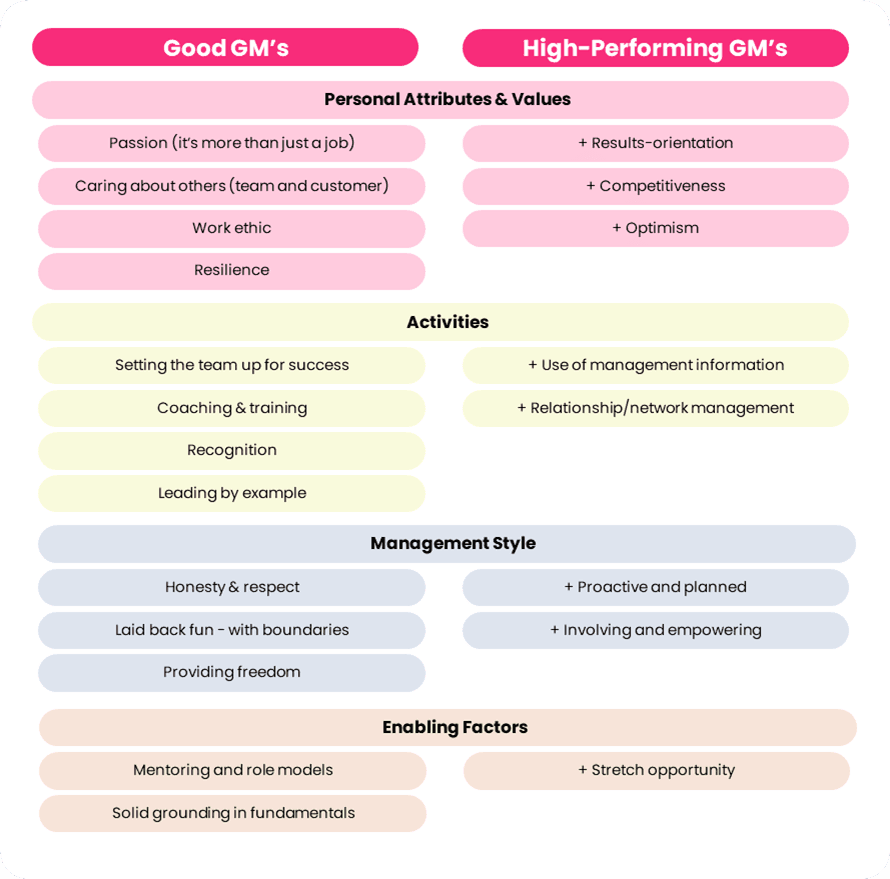
To explore this, our Director of People Science, Rob Robson, led a qualitative research project for a national pub chain. Through in-depth interviews with experienced GMs in July and August 2023, he uncovered the traits, values, and career moments that define top-tier performance. The findings offer a rare glimpse into what truly drives success at the front line.
Our Approach
We conducted semi-structured interviews of around an hour each with a mix of high-performing (as nominated by the client) and “good” (moderately performing) GMs. No underperformers were interviewed.
Discussions explored each GM’s career history, priorities, challenges, barriers to success, and how they navigated them. We also examined their management style and influences, career development - including key events and role models relationships, and aspirations.
The Journey to Excellence
Mentoring
While most GMs said they had “fallen into” hospitality starting front or back of house, they progressed rapidly thanks to mentorship and supportive management. Many talked about someone who had “given them their chance” to step up.
Stretch Opportunities
This leap of faith often provided a defining stretch opportunity, which high performers consistently viewed as pivotal. Most weren’t on formal fast-track programmes; instead, they had a manager who believed in them and helped them see their own potential.
This highlights the importance of systematic talent management encouraging operations managers to identify, discuss, and develop people with potential.
Strong Fundamentals
Many GMs emphasised the importance of learning the fundamentals: understanding the P&L, mastering operational basics, and developing early people-management skills. Some lamented a perceived decline in formal training around these core capabilities.
Competitiveness
A notable difference between groups was how high performers described their career “narrative.” Their stories centred more around achievement: winning awards, hitting standout sales figures, or turning around an underperforming pub.
GM Priorities and Approach
Importantly, this achievement orientation didn’t make high performers individualistic.
Team-First Approach
All GMs talked about the importance of treating people well and building strong relationships. But high performers framed this differently.
- When describing teamwork, they emphasised shared results.
- When discussing development, they focused on preparing their team to step up—empowering and involving them.
- They also spoke more often about setting and maintaining high standards.
Results Orientation
High performers were more open and enthusiastic about sharing business performance, tracking metrics day to day, and comparing their results with other pubs. They took pride in recognition and awards but were quick to share that success with their teams.
Many also balanced competitiveness with collaboration, often helping neighbouring GMs to improve.
Resilient Optimism
All GMs acknowledged the job’s challenges: long hours, scheduling issues, inflexible purchasing, and recruitment difficulties. But again, high performers spoke differently. They acknowledged problems without dwelling on them: the issues were there, “but you just crack on.”
All GMs needed resilience, but high performers coupled it with optimism a belief that the job was still rewarding and worth the effort.
Conclusion
The research showed that good and high-performing GMs share many of the same attributes, approaches, and career experiences. High performers weren’t fundamentally different—they simply demonstrated certain behaviours or mindsets more consistently or more strongly.
Crucially, nearly all had someone who believed in them and offered an opportunity to prove what they could do.
Good to Great: What Separates the Best GMs from the Rest?
Want to learn more about who we are and how we support the hospitality industry?
Find out more about us here.
Download The Hospitality Culture Report
Ready to dive deeper into the data behind these insights? Download The Hospitality Culture Report to explore the full findings.
Download the report