
When the Distance Between Your People and Your Customer Is Thin, Experience Becomes Strategic
In industries where employees are the experience, what your people feel becomes what your customers feel. This post explores why thin‑distance sectors like hospitality rely on employee experience as a strategic driver of performance and how leadership clarity, working systems, and genuine connection turn frontline moments into commercial advantage.
When the Distance Between Your People and Your Customer Is Thin, Experience Becomes Strategic
In some industries, the gap between the people delivering the service and the people receiving it is wafer thin.
- Hospitality
- Retail
- Education
- Care
- Leisure
These are people-powered environments where your employees are the experience. There’s no buffer, no layers, no corporate insulation.
What your customers feel is a direct reflection of what your people feel.
And that makes employee experience not just an HR initiative, but a strategic lever for commercial performance.
This isn’t a warm, fuzzy idea.
It’s structural
It’s observable
And, as the data shows, it’s powerful.
Your People Are the Experience
In hospitality, teams sit right on the frontline of customer interaction. There is no distance between the server and the guest, the bartender and the regular, the receptionist and the arriving traveller.
Our Hospitality Culture Report shows this clearly: the strongest scoring areas, Connection (80.7%), Belonging (78.5%), and Enjoyment (71.4%), sit in what we call the Felt Experience. These are not abstract notions of culture. They are the emotional drivers people bring into each guest interaction.
When your people feel connected, included, and energised, they show up differently. They care more. They stay longer. They deliver better. And the customer feels every ounce of it.
This is what makes thin distance industries fundamentally different:
Your internal experience is your external experience.
But While Employees Are Close to the Customer, Leaders Often Aren’t
Here’s the challenge.
While your people are shoulder to shoulder with customers, leadership is often miles away.
The report highlights a notable gap: Company Leadership scores at just 61.2%, far lower than line management or teamwork. Many employees feel distant from senior leaders and disconnected from the organisation’s wider vision.
And that distance matters.
When leaders are far removed from the customer, the organisation’s ability to influence the customer experience depends on one thing:
The experience they create for the people closest to the customer.
If leaders don’t build clarity, don’t communicate direction, and don’t create the environment for frontline staff to thrive, it shows up immediately in the guest experience, long before it shows up on a dashboard.
Employee Experience Is a Commercial Strategy
The link between people experience and performance isn’t theoretical. The Hospitality Culture Report aligns with wider research showing that engaged employees drive customer loyalty, operational excellence, and ultimately revenue growth.
- Marriott found hotels with higher employee engagement delivered a 22% lift in profitability and 21% increase in productivity through stronger guest satisfaction.
- Gallup’s meta analysis of 276 organisations revealed top quartile engagement units see 10% higher customer loyalty and 23% higher profitability.
- And, within hospitality specifically, the Service Profit Chain remains the clearest model: better employee experience → better customer experience → better financial performance.
In other words:
When the distance to the customer is thin, people experience becomes your competitive edge.
What’s Causing Friction?
If the guest experience is created by your people, then anything that gets in your people’s way becomes a direct customer issue.
The report’s free text analysis is crystal clear about the blockers:
- Organisational effectiveness (processes and systems that hinder rather than help)
- Workload pressure
- Communication gaps
These frustrations appear repeatedly as the biggest drags on employee performance, and therefore customer quality.
When systems don’t work, people work longer.
When communication is unclear, service falters.
When teams don’t feel supported, everything slows down.
These aren’t “employee problems”.
They are guest experience problems in disguise.
Leaders Influence the Experience , Even at a Distance
You don’t need to be in every venue, store, or classroom to influence the experience. But you do need to create the conditions where people can deliver their best.
The Hospitality Culture Report points to four non negotiables:
1.Make leadership visible
Employees feel more connected when they understand the plan, see senior faces, and know that leaders care about their realities.
2.Fix friction quickly
Processes and systems are either accelerators or handbrakes. Teams ask for the basics: working tools, clear communication, dependable processes.
3.Invest in line managers
Line Management scores high in hospitality (70.4%) and is one of the greatest multipliers of performance. They are the bridge between the boardroom and the bar.
4.Prioritise connection
Connection is the highest scoring experience driver for a reason , it fuels pride, performance, and customer warmth.
Experience Is Strategy When Your People Are the Product
When an employee hands a coffee across the counter or welcomes a guest into a dining room, that moment is your brand. Not the logo. Not the website. Not the training manual.
The moment is the brand.
And that moment is shaped long before the customer arrives , by culture, by leadership, by clarity, by systems, and by how people feel when they put on the apron or the name badge.
In industries where the distance between your people and your customer is thin, experience isn’t a programme.
It’s strategy.
It’s performance.
It’s revenue.
It’s reputation.
And the organisations that will thrive in 2026 are the ones that understand this simple truth:
If you want customers to feel it, your people need to feel it first.
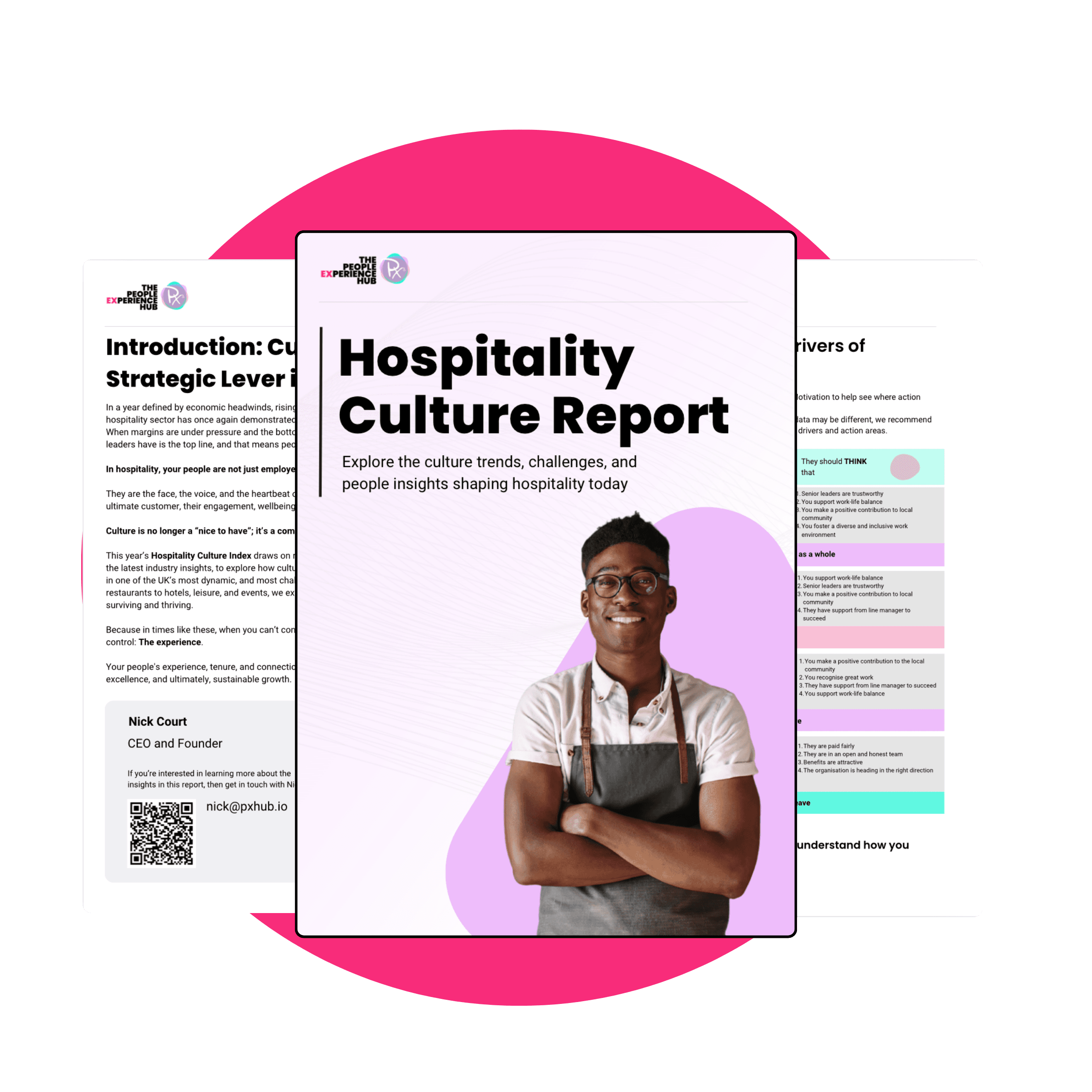
Download The Hospitality Culture Report
Ready to dive deeper into the data behind these insights? Download The Hospitality Culture Report to explore the full findings.
Download the report