
Why the Felt Experience Is the Powerhouse of Hospitality
The Felt Experience: Connection, belonging, enjoyment, and purpose, is the strongest driver of performance in hospitality. When teams feel energised and connected, service quality rises, customer interactions improve, and commercial results follow. This blog shows why emotional experience outperforms structural factors and how leaders can strengthen the human heartbeat of hospitality.
Why the Felt Experience Is the Powerhouse of Hospitality
Walk into any thriving hospitality business, and you’ll feel it before you see it.
The warmth.
The energy.
The effortless rhythm of a team that enjoys being there.
This isn’t luck. It isn’t personality.
It’s felt experience, the emotional reality of working in hospitality, and the data shows it’s the single most powerful driver of performance in the sector.
In hospitality, a gruelling day doesn’t feel quite as gruelling when you enjoy your job, feel a sense of purpose, and feel connected to the people around you. And when your people feel that way, your customers do too.
What does the Data Say?
Our Hospitality Culture Report shows that the strongest scores in the entire dataset sit squarely in the Felt Experience category, specifically:
- Connection – 80.7%
- Belonging – 78.5%
- Enjoyment – 71.4%
- Purpose – 69.8%
These aren’t fluffy cultural add-ons.
They’re the foundations of Hospitality people, and they outperform many practical or structural elements of work by a significant margin.
The message is unmistakable:
How people feel at work is the heartbeat of hospitality.
People who feel connected, included, and energised don’t just turn up, they show up. And that difference shows up again in every customer interaction.
Why Feelings Matter in a Fast-Paced Industry
Hospitality can be as demanding as it is rewarding!
The pace is fast, and the customer-facing nature of the job requires constant emotional energy.
But here’s the thing:
The emotional experience of work buffers the operational pressure.
A tough shift feels less tough when:
- You enjoy the team you’re working with,
- You feel like you belong,
- Your work has purpose,
- And you feel proud of the service you deliver.
This isn’t some random concept; it’s backed up by thousands of employee comments in the free-text analysis of our employee feedback surveys, where connection, enjoyment, teamwork and line management repeatedly appear as top sources of joy at work.
People don’t return shift after shift because service is easy.
They return because the experience of delivering service feels meaningful.
The Felt Experience Drives Customer Experience
In hospitality, the customer experience is a direct reflection of the employee experience. There is almost no distance between the two.
When employees feel connected and proud, that pride is visible:
- In tone of voice,
- In eye contact,
- In how people act when something goes wrong,
- in the warmth of service during busy periods.
Guests don’t just receive service, they feel the way your people feel.
This is why the highest areas of employee sentiment sit at the core of hospitality’s commercial engine.
High felt experience scores create:
- Consistent service,
- Stronger team cohesion,
- Better guest interactions,
- Higher operational reliability.
Our Hospitality Culture Report reinforces this link through the Service Profit Chain: engaged, supported employees drive better customer satisfaction and higher profitability.
In a sector built on human interaction, emotional experience isn’t soft.
It’s strategic.
Connection: The Powerhouse of the Powerhouse
Among all the felt experience factors, Connection stands out as the strongest, scoring 80.7%, the highest score in the entire report.
Hospitality people repeatedly describe connection as the thing that “lights them up”:
- Connection with colleagues,
- Connection with customers,
- Connection with the brand.
Connection is the engine that keeps hospitality moving, the buzz of shared service, the camaraderie of a team tackling a busy shift, the pride of creating memorable guest moments.
When people feel connected, they are:
- More generous with customers,
- More patient with each other,
- More resilient on hard days,
- More creative in solving problems.
This is the stuff that no process manual can teach, but every customer can sense.
But Here’s the Catch: Felt Experience Doesn’t Happen by Accident
High felt experience doesn’t magically appear. It’s shaped by:
Culture, leadership, communication, recognition, and the everyday micro-moments that define working life.
The Hospitality Culture Report highlights that while the felt experience is strong, the perceived environment, communication, people practices, and organisational effectiveness, lags behind, scoring much lower (e.g., People Practices at 60.8%, Communication at 63.3%).
This gap is a risk:
If the environment isn’t supportive, it will eventually erode the emotional experience.
A connected team can’t outrun broken processes forever.
The Opportunity for Hospitality Leaders
If you lead in hospitality, this is your strategic advantage.
Your biggest lever isn't a new product, a new brand activation, or a new scheduling system.
It’s the emotional experience of your people.
To strengthen the felt experience, leaders should focus on:
1.Build and protect connection
Create environments where people know each other, trust each other, and feel part of something.
2.Celebrate purpose
Employees deliver better when they understand how their work makes a difference, and hospitality is full of purpose moments.
3.Make enjoyment acceptable
Enjoyment isn’t unprofessional.
It’s the energy source of great service.
4.Strengthen belonging
People need to feel they can be themselves without fear or judgement, an essential part of engagement and retention.
5.Remove friction
Fix broken processes, unclear communication, and poor systems, because nothing kills emotional energy faster than operational drag.
Hospitality is an industry built on human emotion, warmth, welcome, care, connection.
Your people cannot deliver what they don’t experience.
A gruelling day will always be gruelling.
But a meaningful day?
A connected day?
A day where you feel pride, purpose, and joy?
That’s the day your people remember, and the day your customers feel.
Want to learn more about who we are and how we support the hospitality industry?
Find out more about us here.
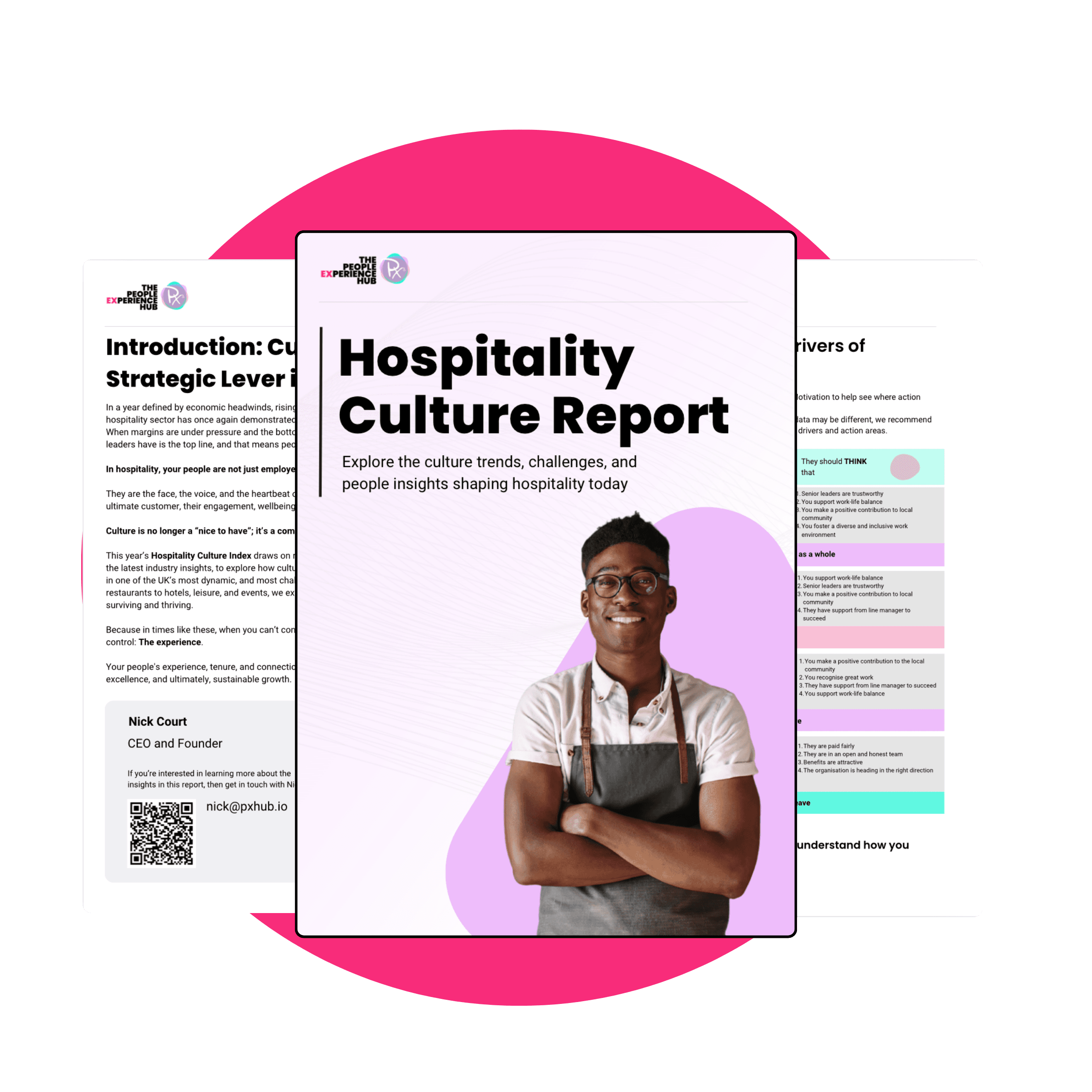
Download The Hospitality Culture Report
Ready to dive deeper into the data behind these insights? Download The Hospitality Culture Report to explore the full findings.
Download the report